Town of Telluride Energy Conservation Code

effective September 12th 2026…

Link to adoption language, Article 15

Adopted the 2024 version of the IECC (zone 6)

Projects must follow the ERI path to compliance.


(2) Section C403.1.1 Calculation of heating and cooling loads is amended by adding “All systems shall be designed by a certified mechanical engineer.”

(3) Section R105.1 General is amended by adding:

Systems shall be designed by a certified Mechanical Engineer for single family residential structures greater than 1,000 s.f. of gross floor area including the basement area.

(4) Additional Requirements for Residential and Commercial Buildings is amended as follows:

a. Cement. All cement used within the Town shall be mixed with western coal fly ash, except such a mix is not required for exterior slabs.

b. Low Volatile Organic Compounds (“VOC”). The general contractor and the property owner shall sign the Homeowner VOC Awareness Checklist provided by the Town prior to the issuance of a certificate of occupancy for a project.

c. Energy Star Ratings. Energy Star rated appliances, exhaust fans and light fixtures shall be installed.

d. Exterior vegetation irrigation systems shall be installed with a moisture sensor and timer to control irrigation.

e. Pools and Spas (Hot Tubs)

i. Exterior swimming pools are prohibited in Telluride unless otherwise approved by the Planning and Zoning Commission pursuant to the use permitted on review development review process contained in the Telluride Land Use Code.
ii. Pools, custom-built hot tubs, or factory-built portable spas shall also meet the Energy Mitigation Program requirements in Section 15-9-40.
iii. Pools, custom-built hot tubs, or factory-built portable spas shall be equipped with a vapor-retardant pool cover on or at the water surface. Pools/spas capable of being heated above 90 deg F must have a pool cover with a minimum insulation value of R-16.

f. Garage Door for heated garages shall have a value of R-18.

(g) Renewable Energy – 100% of the building’s electricity use must be provided for with renewable energy, either produced on-site or purchased through a Green Power production program. Creative alternative options will be considered by the Building Department.


Jump to Energy Conservation Code Hub for; the western slope of Colorado; Aspen, Telluride, Mountain Village, Town of Snowmass Village, Basalt, Carbondale, Pitkin and Eagle County… 

Carbondale’s new Energy Code adoption

Amended energy code has been adopted- goes into effect July 1st 2025

2021 IECC (International Energy Conservation Code) plus the state Electric Ready and Solar Ready Code for Residential and Commercial Buildings has been adopted.

Residential

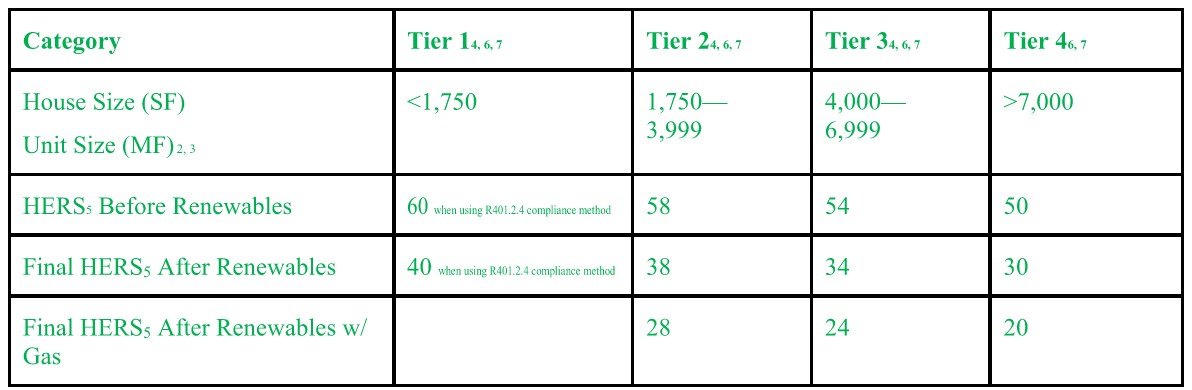
The chart below is the crux of understanding the energy code compliance.

Additional energy efficiency package:

Prescriptive projects must show a Total UA calculation of +5% or better.

ERI projects must show required score +5% Total UA Calculation.

HERS projects must choose ductless heat pump or reduced infiltration rate (3 ACH50) + balanced ventilation.

Balanced ventilation, higher heating, cooling and hot water production efficiency are already mandatory.

Some other things to note…

“All-electric” projects = no gas heat or hot water, cooking and fireplaces do not make the project duel-fuel.

The REBP (Residential Efficient Building Program) has been replaced with the language in Chapter 36 SUSTANABLE BUILDING CONSTRUCTION PRACTICES.

The mandatory PV by square footage requirement only applies to Prescriptive Path Tier 1 projects.

Carbondale is back to considering themselves in climate zone 5.

Minimum air impermeable insulation for condensation control in roofs/ceilings has been increased to R30. (permeable would be R30 for that assembly) (following zone 6 50%/50% rule)

All insulation must be installed to HERS Rater’s grade 1 satisfaction, or is has to be torn out and redone. This includes foundation CI coming all the way up the top of the slab, in all locations (with exception of between the house and garage). This insulation is required to be protected above grade and up to 6″ below grade.

All garages have to be insulated like a heated space.

Hot water efficiency must be at least 90%

Gas fired heating or cooling equipment shall have an efficiency rating of 92% AFUE or better.

All electric Air Conditioning units shall be 15 SEER minimum.

All Heat Pumps must be designated for “Cold Climate” and shall have a HSPF rating not less than 10.


Renovation/addition

>1,750 sf of renovation or addition must just follow the new construction sections.

Multi-family and Commercial

Link to test. You will have to search, text has been missing from Town website…


Jump to Energy Conservation Code Hub for; the western slope of Colorado; Aspen, Telluride, Mountain Village, Town of Snowmass Village, Basalt, Carbondale, Pitkin and Eagle County…


Pitkin County, Colorado’s energy code addendum

Updated energy code effective April 27th 2025.

State electric ready code has been adopted too.

Link to 4-27-2025 adoption text

New construction:

The prescriptive 2021 IECC table has been modified. Most notably .27 U-factor windows mandatory.

New Performance path/ERI/HERS goals: 2021 HERS-PV / HERS+PV
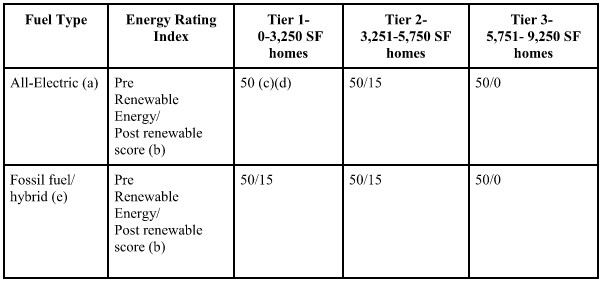
Note that off-site solar is allowed in some circumstances.

All PV requires an energy storage system of 5 kWh or 25% of annual production, whichever is greater.

All projects are requested to provide a release of utilities provider information so usage can be tracked.

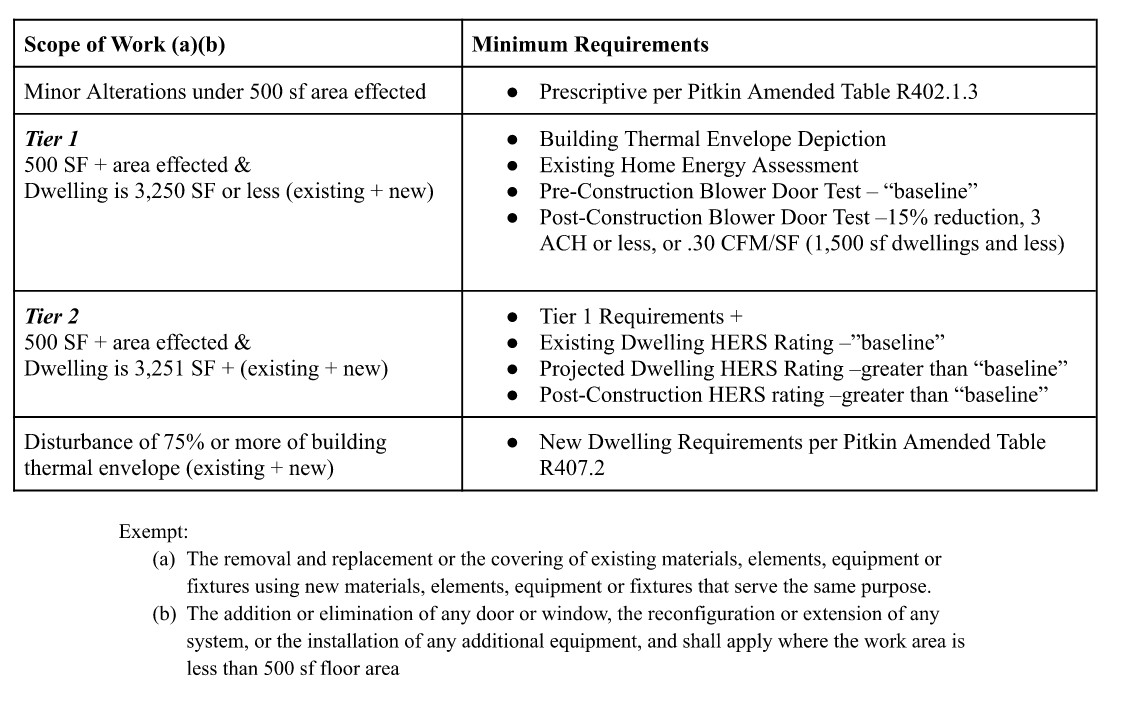
Additions & Alterations: Here’s a handy table…
Additions:

New building envelope assemblies that are part of the addition shall comply with Section R402. (projects can still use UA trade-off)
Additions of 500 square feet or more of floor area shall be divided into two categories and include
the following additional requirements:
Tier 1 dwellings (0-3,250 sf, existing + new): shall be required to conduct a pre-construction
Home Energy Assessment by a certified third party on the existing building. A comprehensive
report of the assessment shall be submitted with the building permit application and include the
following criteria:
1. Annual Energy Consumption
2. Existing Building Envelope Air Leakage Test
3. Recommended Building Envelope Upgrades
4. Recommended HVAC Upgrades
5. Recommended Water Heating Upgrades
6. Recommended Health and Safety Upgrades
7. Recommended Lighting and Appliance Upgrades
A post-construction Air Leakage Test shall be performed on the existing building and addition prior
to Final Building Inspection demonstrating a 15% reduction in air leakage.

Tier 2 dwellings (3,251 sf and above, existing + new): shall be required to conduct a pre-construction
Energy Rating Index Assessment performed in accordance with ANSI/RESNET/ICC
301, on the existing dwelling, as well as a projected rating including the addition to document any
level of improvements made and to ensure that the home does not perform worse than it did prior to
the addition in accordance with Section R502.1. In addition to the Energy Rating Index, a
comprehensive report of the assessment shall be submitted with the building permit application and
include the same criteria as in Tier 1. A post construction assessment shall be submitted prior to
Final Building Inspection to demonstrate compliance. A post-construction Air Leakage Test shall
be performed on the existing building and addition prior to Final Building Inspection demonstrating
a 15% reduction in air leakage.
Exception: New envelope assemblies in additions less than 500 square feet in area are exempt from
the requirements of Section R402.4.1.2, R402.4.1.3.

Alterations:

Building envelope assemblies that are part of the alteration shall comply with Section R402. (projects can still use UA trade-off)
Alterations of 500 square feet or more of floor area shall be divided into two categories and include
the following additional requirements:

Tier 1 dwellings (0-3,250 sf): shall be required to conduct a pre-construction Home Energy
Assessment by a certified third party on the existing building. A comprehensive report of the
assessment shall be submitted with the building permit application and include the following
criteria:

1. Annual Energy Consumption
2. Existing Building Envelope Air Leakage Test
3. Recommended Building Envelope Upgrades
4. Recommended HVAC Upgrades
5. Recommended Water Heating Upgrades
6. Recommended Health and Safety Upgrades
7. Recommended Lighting and Appliance Upgrades
A post-construction Air Leakage Test shall be performed on the existing building and alteration
prior to Final Building Inspection demonstrating a 15% reduction in air leakage.

Tier 2 dwellings (3,251 sf and above): shall be required to conduct a pre-construction Energy
Rating Index Assessment performed in accordance with ANSI/RESNET/ICC 301, on the existing
dwelling, as well as a projected rating including the alteration to document any level of
improvements made and to ensure that the home does not perform worse than it did prior to the
proposed alteration in accordance with Section R503.1. In addition to the Energy Rating Index, a
comprehensive report of the assessment shall be submitted with the building permit application and
include the same criteria as in Tier 1. A post construction assessment shall be submitted prior to
Final Building Inspection to demonstrate compliance. A post-construction Air Leakage Test shall
be performed on the existing building and addition prior to Final Building Inspection demonstrating
a 15% reduction in air leakage.

Exception: Alterations defined below shall not be required to comply with the required assessments
of this section provided that the energy use of the building is not increased.

1. The removal and replacement or the covering of existing materials, elements, equipment or
fixtures using new materials, elements, equipment or fixtures that serve the same purpose.
2. The addition or elimination of any door or window, the reconfiguration or extension of any
system, or the installation of any additional equipment, and shall apply where the work area
is less than 500 sf floor area.
3. Alterations exposing or demolishing more than 75% of the building’s thermal envelope area
shall comply with the energy requirements of Section R407

Renewable Energy Mitigation Program (REMP) Calculators:

REMP (XLS)- Version 2025- Coming April 2025         https://pitkincounty.com/192/Building


Effective 12-15-2023

  • County-wide cap on home size; 9250 square feet.
  • Some special areas have a smaller cap at 8250 or 5750 sf.

https://pitkincounty.com/1566/Pitkin-County-Code-Updates

Effective 3-13-2024

  • 2021 IECC
  • Title 11.32 adopts an exterior energy budget of 200 Million Btu’s, 6000 sf snowmelt cap
  • Title 11.34 adopts electric ready provisions; homes must be EV ready and must use electric for heating, cooling and water heating, or provide the electrical infrastructure to convert to electric in the future.

https://pitkincounty.com/DocumentCenter/View/32664/2024-Energy-Code


Confluence Architecture & Sustainability can help with REMP calculations and provide all the documentation, modeling, testing and certification required to navigate the code.

Jump to Energy Conservation Code Hub for; the western slope of Colorado; Aspen, Telluride, Mountain Village, Town of Snowmass Village, Basalt, Carbondale, Pitkin and Eagle County…
 

Town of New Castle Energy Code

The Town of New Castle has a unique approach. They do not require a HERS Rating, but they do require a rater-like Building Science technician to inspect construction and fill out their checklist…

2021 Energy Code Building Inspector Checklist

2023 Colorado Model Electrical and Solar Ready Codes

https://www.newcastlecolorado.org/media/3591


We do that…

Please give us a call and we can help navigate the process in the most cost-effective way. And optimize your construction for performance.

Jump to Energy Conservation Code Hub for; the western slope of Colorado; Aspen, Telluride, Mountain Village, Town of Snowmass Village, Basalt, Carbondale, Glenwood Springs, Pitkin, Eagle and Garfield Counties…


Basalt Colorado’s energy conservation code requirements

Link to Town Building Department website…

The Town of Basalt, Climate Zone 6B, is currently on the 2021 IECC (International Energy Conservation Code).

Took effect June 13th 2023


The 2024 SBR Amendment took effect on November 12th 2024.

The full SBR Ordinance can be found here:
Sustainable Building Regulations 2024 Ordinance

(1) Prescriptive via REScheck: (option available only when new construction and additions ≤
2,000 sf of conditioned floor area) via REScheck. The proposed design must
exceed compliance by a minimum of 10% comply with the requirements of Sections R401
through R404. All items listed in the Requirements Checklist in the REScheck must also be
addressed.
For all remodels IECC Chapter 5 – Existing Buildings shall apply.
(2) HERS Rating: A HERS score of 52 must be achieved for a residence utilizing both gas and
electricity. For an all-electric or Electrification-ready residence, a HERS score of 55 is
required. The HERS report shall include the HERS Certificate and the Building Summary
Report. Resubmittal of documents is required when as-built conditions occur, prior to
issuance of a Certificate of Occupancy.
If a project does not meet the required HERS score, at the SBR building final, a calculated fee of $0.25
multiplied by the conditioned floor area, multiplied by the number of points short shall apply and be
paid prior to final.


We do that…

Please give us a call and we can help navigate the process in the most cost-effective way. And optimize your construction for performance.

Jump to Energy Conservation Code Hub for; the western slope of Colorado; Aspen, Telluride, Mountain Village, Town of Snowmass Village, Basalt, Carbondale, Pitkin and Eagle County…

Town of Mountain Village Energy Code

As of May 16th 2024…

2021 International Energy Conservation Code

Special provisions for exterior energy use.

Permit fee discounts available for nonexistent or offset exterior energy uses.

Link to Town website and adoption language…

CFA TOMV yes snowmelt no snowmelt
< 3600 Tier I prescriptive prescriptive
3601-7000 Tier II 2021 HERS 60 2021 HERS 60
7001-13000 Tier III 2021 HERS 55 2021 HERS 60
13001+ Tier IV 2021 HERS 50 2021 HERS 60


Mechanical rooms and unconditioned space in new construction in the Town of Mountain Village

As a policy we are allowing for mechanical rooms, and unconditioned garages to be exempted from habitable HERS calculations with the following criteria;

  • No heating of any type will be permitted in these locations
  • Exterior envelope insulation requirements shall be met for ALL walls, ceilings and floors (per the HERS design), with a designed thermal break at floors, including concrete (Check with your engineer as this may cause problems with structural slabs).
  • Doors to these rooms shall be fully gasketed
  • At least one, or a minimum of 25% of the walls shall be directly adjacent to the exterior of the structure.

As you are aware, our CDC and the 2018 IECC do not specifically provide for the installation of PV systems to offset HERS ratings in a residential application. The allowance above will hopefully provide for an easier time of meeting the HERS requirements of the Town, and meets prescriptive requirements. In the future, if one of your raters can provide additional information to review that will support the PV to HERS tradeoff, we are available to review.

Thank you and please contact me with any questions


Lars Forsythe

Building Inspector

Building Department

Town of Mountain Village

455 Mountain Village Blvd, Suite A

Mountain Village, CO 81435

O :: 970.369.8246

C :: 970.729.3439


Performance HERS changes
Currently the Mountain Village Building Regulations has adopted the 2018 energy code. Per (section 17.7.12.7.i.D) renewable energy sources can be used to lower the HERS score if the Smart Build Program is utilized. Buildings designed with a HERS rating below 50 is the starting threshold to allow the renewable offset. It has come to my attention that RESNET/ICC 301 allows for renewable energy sources to be used to lower the HERS score. In keeping with our commitment to support renewable energy the Mountain Village Building Department has reviewed this document and will allow renewable energy to aid in lowering the HERS score. Effective immediately the Mountain Village Building Department will allow all new residential projects to utilize renewable energy sources to lower the HERS score providing:
(1) All 2018 IECC Residential Mandatory requirements in chapter 4 are utilized.
(2) Depending on the type of construction the minimum requirements of 2018 IECC Tables 402.1.2, 402.1.4 and 402.2.6 are followed prior to the addition of the renewable energy source to assist in the HERS score.
(3) Building Regulations section (17.7.12.D. V.I. A), the onsite renewable energy system will be required to be maintained and operational for the lifetime of the property, through a written agreement with the property owner and a covenant on the property.
Inspection Changes as follows:
The Mountain Village Building Department will require the Performance Rater to perform all the insulation inspections. The Performance Rater will be required to sign off on the pre-drywall inspection prior to drywall being installed as well as any partial inspections. An acceptance email must be sent to the building department for all inspections as well as the final acceptance certificate prior to CO being issued. The Building Department will provide a red line stamp on the reviewed plans stating (3rd party insulation inspection required) to help the contractor be aware of this requirement. The following emails may be utilized for the acceptance reports: larsforsythe@mtnvillage.org and dharrington@mtnvillage.org.
Sincerely Drew Harrington
Chief Building Official
970- 708-7537
970- 369-8251


Link to Colorado Energy Conservation Code Hub for; Aspen, Basalt, Carbondale, Eagle County, Pitkin County, Town of Snowmass Village and the Town of Mountain Village

Garfield County adopts the 2018 IECC

Effective June 16, 2023

Garfield County has adopted the 2018 International Energy Conservation Code (IECC).

The 2018 version of the IECC features minor changes in insulation values and requires a blower door test to be performed on all new homes to check air-sealing.

Occupant ventilation enforced.

Duct leakage testing enforced if any part of the duct system leaves the thermal envelope.

GarCo will be using the 2021 IECC for multi-family projects; including the provision that lets units under 1500 square feet test for infiltration under the easier surface area metric.

We do that…

Please give us a call and we can help navigate the process in the most cost-effective way. And optimize your construction for performance.

Jump to Energy Conservation Code Hub for; the western slope of Colorado; Aspen, Telluride, Mountain Village, Town of Snowmass Village, Basalt, Carbondale, Glenwood Springs, Pitkin, Eagle and Garfield Counties…

City of Glenwood Springs Energy Conservation Code

On June 6, 2022, the City will require building permits to use the 2021 editions of the International Building Code, International Residential Code, International Mechanical Code, International Existing Building Code and International Energy Conservation Code.


We do that…

Please give us a call and we can help navigate the process in the most cost-effective way. And optimize your construction for performance.

Jump to Energy Conservation Code Hub for; the western slope of Colorado; Aspen, Telluride, Mountain Village, Town of Snowmass Village, Basalt, Carbondale, Glenwood Springs, Pitkin and Eagle County…

Aspen’s 2021 Energy Code Adoption

Aspen’s adoption of the 2021 I-codes is heavily modified. This article looks only at the energy conservation parts of the adoption. And this is just a summary of the most perennate changes that may influence design.

Link here to the actual adoption documents… 

Four compliance paths:

  1. Prescriptive/Building UA/R-value alternative +23% including all additional mandatory requirements
  2. Performance +5%
  3. ERI +5% (2021 ERI 50.35)
  4. Existing building, Chapter 5

Notable modifications to mandatory residential energy requirements:

  • Prescriptive envelope requirements: R60 roof, R40 walls, R20 basement walls, windows max U-factor of .26 (inert gas with uncapped breather tube units don’t count)
  • Max 30% glazing to wall area (garage and sunroom glazing counts)
  • 1.5 ACH50 air leakage
  • ERV/HRV and flow testing required
  • Duct leakage testing was stricken for the Prescriptive path
  • Special provisions to avoid Thermal bridging
  • Commissioning
  • Sign Up for Building IQ benchmarking program (data gathering)
  • Sensible electric ready provisions
  • New triggers for energy efficiency requirements for alterations

Commercial Energy Changes:

  • Prescriptive, 2019 ASHRAE 90.1 or Performance
  • Envelope infiltration testing; Dwelling and sleeping units .30 CFM50 per square foot of envelope, everything else .40 CFM75 per square foot of envelope.
  • ventilation flow testing
  • Enhanced envelope, especially walls
  • EV requirements
  • Electric ready provisions
  • New triggers for energy efficiency requirements for alterations

Expanded REMP:

  • Heat tape, gas fireplaces, outdoor heaters will now need to be offset
  • Gas fireplaces will be required to be sealed combustion
  • 200,000,000 BTU/year cap for all exterior energy
    • Snowmelt 2414 ft2 OR,
    • Pool 603 ft2 OR,
    • Spa 466 ft2 OR,
    • Heat tape 3125 linear feet of typical heat tape

Incentivize All-Electric New Construction:

  • Expedited Permit Review
  • AC units must be heat pumps

A practical example:

What if a project needs to break with the Prescriptive path? For instance, how can a house go about complying with more than 30% glazing? The project would be forced to try and comply by using either the Performance Path or the ERI (Energy Rating Index) Path.

Minimum Performance goal would be…   2021 Building UA +23% & 72% of Energy costs

Minimum ERI goal would be…                   2021 Building UA +15 % & ERI 50.35 – PV

Both of these goals would have to be achieved without help from PV solar.


We do that…

Please give us a call and we can help navigate the process in the most cost-effective way. And optimize your construction for performance.

Jump to Energy Conservation Code Hub for; the western slope of Colorado; Aspen, Telluride, Mountain Village, Town of Snowmass Village, Basalt, Carbondale, Glenwood Springs, Pitkin and Eagle County…